Matted or Difficult-to-Groom Cat? How Professional Cat Grooming Can Help
27 August 2026
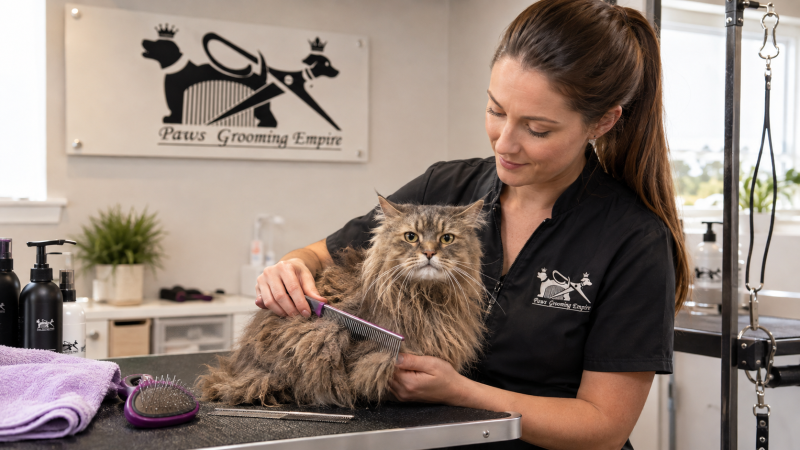
Professional cat grooming can help with matted fur, nervous cats and difficult coats. Learn when to seek expert grooming and how Paws Grooming Empire can help.
Finding a few knots in your cat's coat is one thing. Discovering that large areas have become tightly matted can be much more worrying.
You may try to brush the mats out, only for your cat to pull away, hiss, scratch or attempt to bite. At that point, many owners face two connected problems:
How do I remove the matted fur without hurting my cat, and how can anyone groom them if they won't tolerate being handled?
These problems are often closely linked.
Matted fur can pull tightly against the skin and become uncomfortable. A cat that normally tolerates brushing may therefore become defensive when a painful or sensitive area is touched. Cats Protection also advises that sudden aggression can sometimes be associated with pain, so a noticeable change in behaviour should not simply be dismissed as a cat being "difficult".
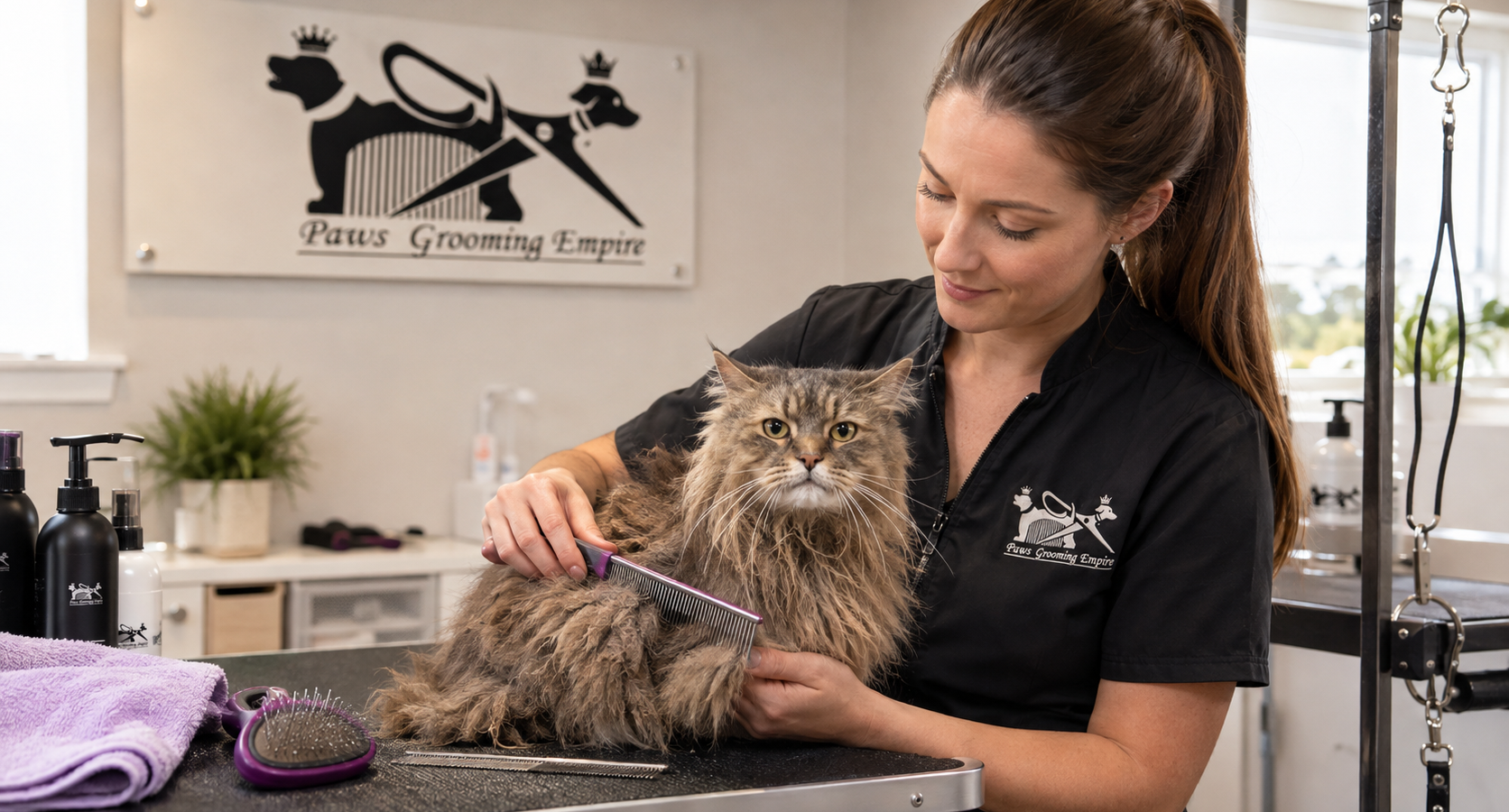
At Paws Grooming Empire, we provide professional cat grooming in North London, including full grooms, de-matting, coat maintenance and nail care, with an approach tailored to the individual cat rather than forcing every cat through the same routine.
What Should I Do If My Cat's Fur Is Badly Matted?
If your cat's coat has become badly matted, the first rule is simple:
Do not pull, tug or try to cut tightly matted fur away with ordinary scissors.
Cat skin is delicate and can be drawn up inside a tight mat. This makes it difficult to tell where the fur ends and the skin begins.
The RSPCA specifically advises against attempting to cut matted cat fur with scissors because of the risk of accidentally cutting the skin.
How can you tell if the matting is becoming serious?
You may notice:
● Hard or felt-like sections of fur
● Several knots joining together
● Mats sitting very close to the skin
● Clumps behind the ears or beneath the legs
● Tangled fur around the tummy or hindquarters
● Fur that cannot be separated with a normal comb
● Your cat flinching when a particular area is touched
● Hissing, scratching or biting during brushing
● Redness or irritation underneath the coat
● Your cat grooming one area repeatedly
● Your cat avoiding grooming altogether
Severe matting should not be treated as simply a cosmetic issue.
Cats Protection warns that neglected fur can become matted and uncomfortable, and some severe cases may eventually require veterinary removal.
Why Does Matted Fur Become So Uncomfortable?
A mat begins when loose or tangled hair becomes compacted together.
As more hair becomes trapped, the knot can become tighter and sit increasingly close to the skin.
Every time your cat walks, stretches, jumps or changes position, that tight fur can pull against the skin.
This can explain why a cat that usually enjoys being stroked suddenly becomes unhappy when someone touches a particular part of their coat.
It also explains why attempting to brush severe mats out at home can sometimes make the situation worse.
This is where professional cat grooming becomes important
Instead of continuing to fight with the coat at home, an experienced groomer can assess:
● How severe the matting is
● Where the mats are located
● Whether they can be worked through safely
● Whether clipping is more appropriate
● The condition of the skin underneath
● How your cat responds to handling
● Whether the groom can be completed comfortably
Paws Grooming Empire specifically provides coat maintenance, de-matting and hygiene treatments through its feline grooming service. Its long-haired cat grooming service can include de-shedding, removal of matted areas where necessary, nail clipping, ear cleaning and a hygiene trim.
Can a Groomer Remove Very Bad Matting?
In many cases, yes.
But professional de-matting does not mean endlessly brushing and pulling until every knot eventually comes out.
The priority should be your cat's comfort and welfare.
If a mat is relatively loose, it may be possible to carefully work through it.
If the coat has become tightly felted against the skin, clipping or shaving the affected area may be kinder than repeatedly attempting to brush it out.
Paws Grooming Empire advises seeking professional help for severe matting and notes that heavily matted coats may need clipping rather than prolonged detangling.
Sometimes the result may mean the coat needs to be taken shorter than an owner originally expected.
That is not a failed groom.
Removing uncomfortable matting safely is more important than preserving a particular hairstyle.
Once the damaged or matted coat has been removed, you can work with your groomer on a routine designed to prevent the same problem developing again.
My Cat Becomes Aggressive When Groomed. Can You Still Groom Them?
Potentially, yes.
But the first question should be why the cat is behaving aggressively.
Hissing, swiping, growling or attempting to bite can be ways of saying:
"I am frightened."
"That hurts."
"I have had enough."
This becomes particularly relevant when a cat is badly matted.
A cat may not object to grooming itself. They may object to someone touching an area where the coat is pulling painfully against their skin.
The RSPCA notes that pain or fear can be associated with aggressive behaviour in cats. Cats Protection similarly advises veterinary assessment where aggression develops unexpectedly because an underlying medical cause should be considered.
An "Aggressive Cat" May Actually Be a Frightened Cat
Labelling a cat as aggressive does not tell us very much about what is causing the behaviour.
A professional groomer should look at the whole situation.
For example:
● Has your cat previously been groomed?
● Do they tolerate brushing at home?
● Are there painful mats?
● Are they frightened by unfamiliar people?
● Do they dislike certain areas being touched?
● Have they had a stressful grooming experience previously?
● Are they elderly or less mobile?
● Has their behaviour changed recently?
● How quickly do they become overstimulated?
Understanding these factors can help determine how the appointment should be approached.
How Can a Professional Groomer Work With a Nervous or Defensive Cat?
Cat grooming should not become a battle.
For nervous or reactive cats, the groom may need to be adapted around what that particular cat can comfortably tolerate.
That can mean:
Slower handling
Allowing the cat time to become familiar with the environment before immediately beginning intensive grooming.
Reading body language
Flattened ears, tail flicking, tense posture, skin twitching, growling or attempts to move away can all indicate that the cat is becoming uncomfortable.
Taking breaks
A short pause can sometimes prevent anxiety from escalating further.
Prioritising essential work
If a cat is severely matted, dealing with the uncomfortable areas may be more important than completing every optional part of the groom.
Adjusting the groom
Some cats can manage a full session. Others may need a shorter or more carefully staged approach.
Paws Grooming Empire recommends adapting grooming according to a cat's temperament and stopping or changing the approach when stress increases.
What If My Cat Is Extremely Aggressive?
There are limits to what should safely be attempted within a grooming salon.
If a cat is extremely distressed, repeatedly attempting to bite or appears to be in significant pain, continuing simply to finish the groom may not be appropriate.
Likewise, if aggression has appeared suddenly when your cat previously tolerated handling, speak to your vet.
Cats Protection recommends veterinary advice when aggression develops because pain or another medical problem can sometimes contribute to behavioural changes.
Very severe matting, significant skin problems or cats requiring sedation may also require veterinary involvement.
A responsible professional groomer should recognise when a grooming issue has become a veterinary issue.
From Matted Coat to Full Groom: What Happens Next?
Once your groomer understands both your cat's coat condition and temperament, they can decide what grooming is actually appropriate.
This is where the idea of a full cat groom comes in.
A full groom should not simply mean doing the largest possible number of treatments.
It should mean giving the cat the coat and hygiene care they need while adjusting the process to their individual condition and tolerance.
What Is Included in a Full Cat Groom?
The exact service can vary according to your cat's breed, coat condition and grooming needs.
For long-haired cats, Paws Grooming Empire's grooming service includes elements such as:
● Nail clipping
● Ear cleaning
● De-shedding
● Removal of matted areas
● Clipping or shaving matted sections where necessary
● Hygiene trimming
● Coat maintenance tailored to the individual cat
The important part is that the groom should respond to the cat in front of the groomer.
A Persian with a dense, tangled coat may need something quite different from a British Shorthair that mainly needs help with shedding.
Likewise, an elderly cat that struggles to groom its hindquarters may require a different approach from a young cat attending for preventative maintenance.
1. Coat Assessment
Before significant grooming begins, the coat needs to be assessed.
The groomer can identify:
● Mats
● Tangles
● Excess undercoat
● Areas prone to knotting
● Coat condition
● Sensitive areas
● Hygiene concerns
This assessment helps determine whether brushing, de-shedding, clipping or a combination of techniques is appropriate.
2. De-Shedding and Coat Maintenance
Removing excess loose coat can make the fur easier to maintain at home and reduce the amount of dead hair available to form future tangles.
This is especially useful for cats with dense or long coats.
3. Mat and Tangle Removal
Any matted areas can be assessed individually.
Minor tangles may be manageable with careful grooming.
Tight or extensive matting may need to be clipped rather than pulled through.
Again, comfort comes before appearance.
4. Hygiene Trim
Long-haired cats can sometimes develop problems around the hindquarters where fur may collect litter or dirt.
A hygiene trim can make this area easier to maintain between appointments.
5. Nail Clipping
Nail care can form part of a professional grooming routine, particularly for cats whose claws are becoming long or prone to snagging.
Paws Grooming Empire offers cat nail trimming alongside its wider feline grooming services.
6. Ear and General Coat Check
Grooming gives the groomer an opportunity to look closely at areas an owner may not routinely see beneath a thick coat.
However, a groomer is not a substitute for your vet.
If the groom reveals sores, significant redness, unusual lumps, persistent skin irritation or other potential health concerns, veterinary advice may be recommended.
Why Regular Grooming Is Easier Than Emergency De-Matting
One of the most important lessons after dealing with a badly matted cat is preventing the problem from returning.
Waiting until the coat has become severely tangled creates several problems at once:
The mats become harder to remove.
The cat may become more uncomfortable.
Handling can become more stressful.
The grooming session becomes more intensive.
This is why regular coat maintenance is usually far easier for both the owner and the cat.
Cats Protection advises daily brushing for many long-haired cats to help prevent tangles and matting, while short-haired cats generally require less frequent brushing.
Professional grooming can then support your home routine rather than being reserved only for emergencies.
How Paws Grooming Empire Can Help
If your cat has become badly matted or is difficult to groom at home, you do not need to keep struggling with the coat yourself.
Paws Grooming Empire provides professional cat grooming in North London with a calm, cat-first approach, including full grooming, mat removal, nail trims and coat maintenance.
The salon's Senior Cat Grooming Specialist, Arya, has more than 11 years of dedicated professional cat grooming experience and specialises in feline grooming, including coat maintenance, de-matting and hygiene treatments.
This is particularly valuable when dealing with cats who:
● Have severely tangled coats
● Have not been professionally groomed before
● Become nervous during brushing
● Attempt to scratch or bite when mats are touched
● Have long or dense coats
● Struggle to groom themselves
● Need regular professional coat maintenance
Rather than treating every cat in exactly the same way, the aim is to understand what your cat needs and what they can comfortably manage.
Frequently Asked Questions
What should I do if my cat's fur is badly matted?
Avoid pulling at severe mats or cutting them out with ordinary scissors. Tight mats can sit extremely close to the skin, increasing the risk of injury. Arrange an assessment with an experienced professional groomer. If the skin is sore, damaged or your cat appears to be in significant pain, contact your vet.
Can you groom an aggressive cat?
Some nervous or defensive cats can be professionally groomed using an adapted, patient approach. However, the reason for the aggression matters. Pain, fear and severe matting can all make handling more difficult. Sudden or severe aggression should be discussed with your vet.
Will my cat need to be shaved if they are badly matted?
Not necessarily. It depends on how tight and extensive the matting is. Small tangles may sometimes be removed without clipping, while heavily felted sections may need to be clipped for the cat's comfort.
What is included in a full cat groom?
At Paws Grooming Empire, long-haired cat grooming can include nail clipping, ear cleaning, de-shedding, mat removal, shaving matted areas where necessary and hygiene trimming. The precise groom should be adapted to your cat's coat and temperament.
What if my cat will not tolerate the whole groom?
The cat's welfare should take priority over completing a checklist. Depending on their behaviour and coat condition, the groom may need to be adapted, paused or approached differently. If safe grooming is not possible, veterinary support may be recommended.
Is Your Cat Matted or Difficult to Groom at Home?
A badly matted coat rarely becomes easier by leaving it for another few weeks.
And if your cat is already hissing, scratching or running away when you attempt to brush them, repeatedly forcing the issue at home can make grooming increasingly difficult.
Professional help can address both sides of the problem: the condition of the coat and your cat's experience of being groomed.
At Paws Grooming Empire, we provide professional cat grooming from our North London salon at 28 Aylmer Parade, London N2 0PE, with full grooms, de-matting and coat-care services tailored to your cat.
If your cat's coat is becoming matted, difficult to manage or increasingly stressful to groom, book a professional cat grooming appointment with Paws Grooming Empire before the problem becomes more severe.